
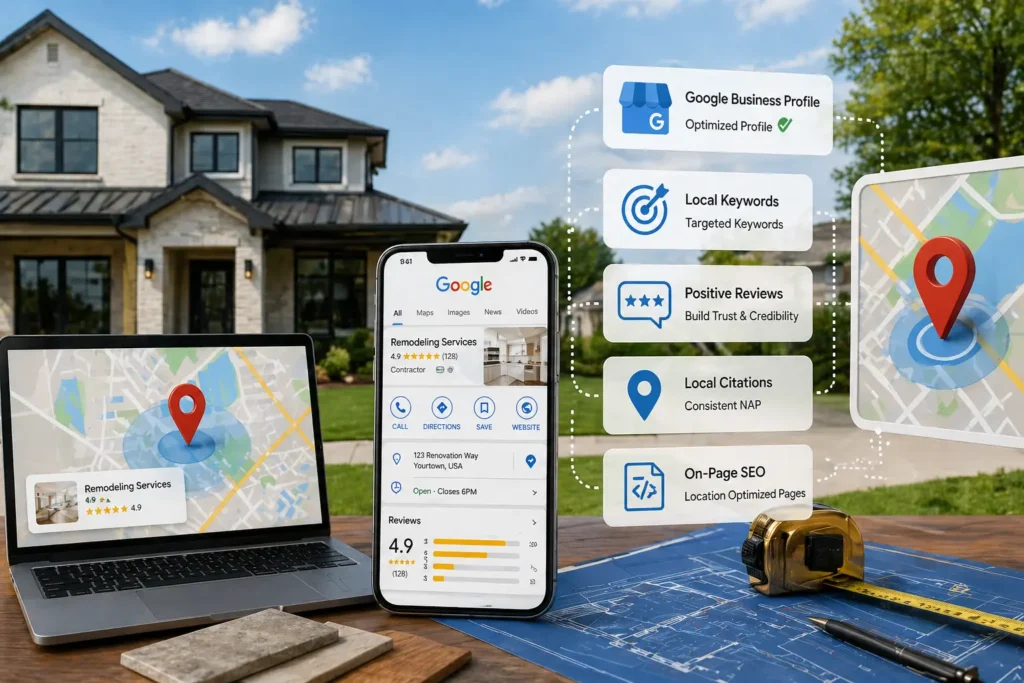

Most homeowners don’t flip through a phone book anymore. They pick up their phone and search. If your remodeling business doesn’t show up in those results, you’re losing jobs to competitors who do.
That’s the problem local SEO solves.
Quick Answer: Local SEO helps remodeling businesses show up when nearby homeowners search for services like “kitchen remodeling near me” or “bathroom renovation in [city].” It works through three main areas: your Google Business Profile, your website content, and your online reputation. Get these right, and Google will put your business in front of people who are ready to hire a contractor.
How Local Search Algorithms Work
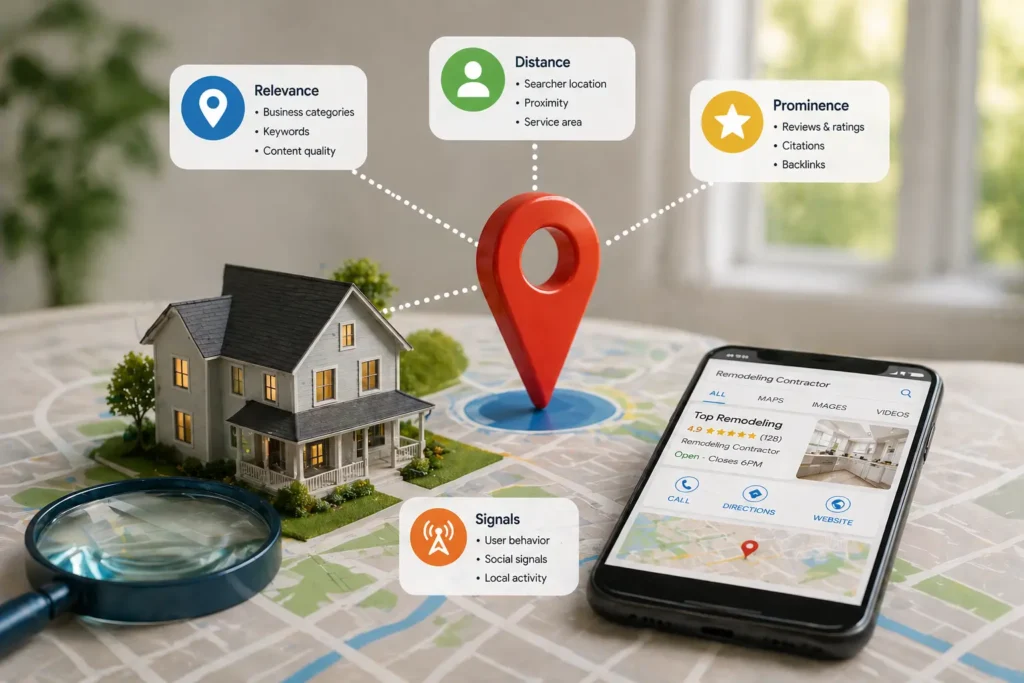
When someone searches “home remodeling contractor near me,” Google doesn’t just pull up random results. It runs through a process to find the most relevant local businesses. Three ranking factors drive this.
Relevance is about match quality. Google looks at your business listing and website to see if your services match what the person searched for. A contractor who clearly lists “bathroom remodeling” on their site will outrank one with vague, generic service descriptions.
Distance is exactly what it sounds like. Google favors businesses that are physically close to the person searching. You can’t move your shop, but you can tell Google exactly where you operate through your service area settings.
Prominence measures how well-known your business is online. Reviews, backlinks, citations, and consistent mentions across the web all feed into this. A newer business can beat an older one if it has stronger prominence signals.
These three factors interact. A business five miles away with 80 reviews can outrank a competitor two miles away with none. Prominence often wins.
Optimizing Google Business Profile
Your Google Business Profile (GBP) is the most powerful tool you have for local SEO. It controls how your business appears in Google Maps and the local pack that cluster of three business listings near the top of search results.
If you haven’t claimed your profile yet, do that first. It’s free.
Once you have access, here’s what matters:
Primary category. Pick the category that best describes your core work. Options like “General Contractor” or “Remodeling Contractor” are common choices. Your primary category carries the most weight.
Complete every field. Business hours, phone number, website URL, and a clear business description. Profiles with gaps rank lower than complete ones.
Add project photos. Before-and-after photos perform well. Post them regularly, at least a few times a month. Google rewards profiles that stay active.
List your services individually. Don’t just say “remodeling.” Add kitchen remodeling, bathroom renovation, basement finishing, and whatever else you offer. Use the words your customers actually type.
Use GBP posts. These short updates appear in your profile. Use them to share finished projects, seasonal offers, or news about your business. Fresh content keeps your profile visible.
Reply to every review. A short thank-you to a good review. A calm, professional reply to a bad one. Both show Google and potential clients that you’re engaged and reliable.
On-Page SEO for Remodeling Websites
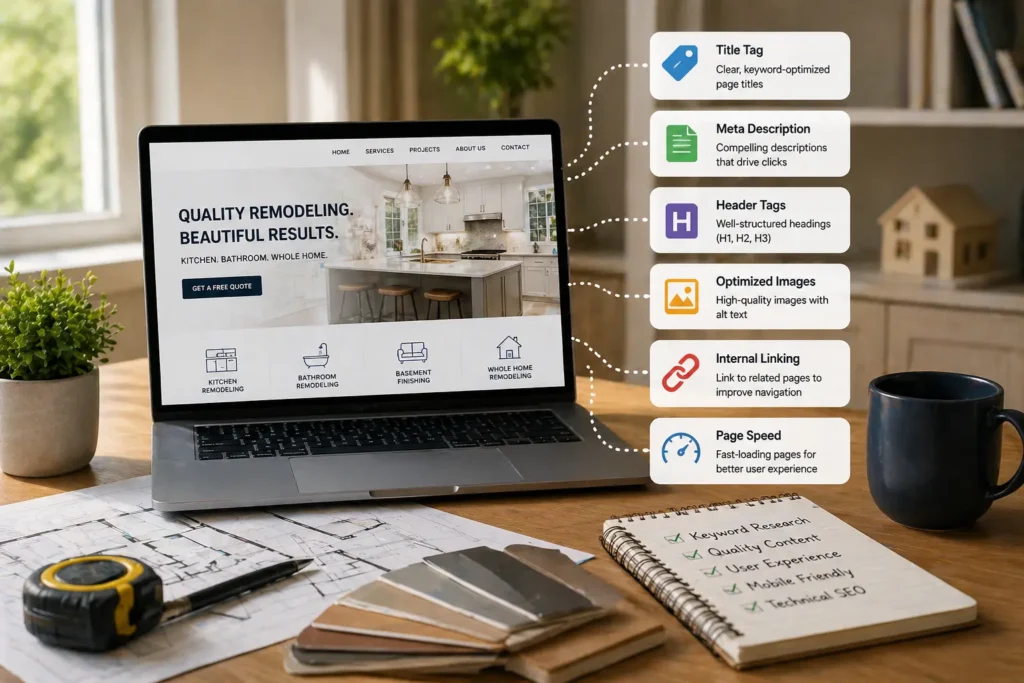
Your website is your second most important asset for local SEO. But a generic “Services” page won’t cut it. You need pages built around specific services and locations.
Create location service pages. Build a separate page for each major service in each city or area you work in. A page titled “Kitchen Remodeling in Denver, CO” will perform far better than a single catch-all services page.
Put keywords in your title tags and H1 headings. The title tag is the blue clickable link in search results. It should name your service and your location. Example: “Bathroom Remodeling in Phoenix, AZ | [Your Company Name].”
Write clear meta descriptions. This is the short sentence under your title in search results. It doesn’t directly affect rankings, but a well-written one gets more clicks.
Add schema markup. This is a piece of code that helps Google read your business details, your name, address, phone number, and the services you offer. Most website builders let you add this through a plugin or built-in tool.
Link your pages together. When your kitchen remodeling page links to your bathroom remodeling page, it helps Google understand your site structure. It also keeps visitors browsing longer.
The Importance of Local Citations and Listings
A local citation is any online mention of your business name, address, and phone number, often called NAP. These appear on sites like Yelp, Angi, HomeAdvisor, the Better Business Bureau, and dozens of local directories.
Citations tell Google your business is real. The more consistent they are, the stronger the trust signal.
The problem most remodeling businesses run into is inconsistency. If your business shows up as “ABC Remodeling” on one site and “ABC Remodeling LLC” on another, Google sees two different businesses. That hurts your rankings.
Go through each directory and make sure your name, address, and phone number match exactly across all listings. Then work on adding your business to directories where it doesn’t appear yet. This takes time, but the benefits accumulate steadily.
Reviews and Reputation Management
Reviews are one of the strongest ranking signals in local SEO. More reviews. Higher ratings. Recent feedback. All of it matters.
But here’s the thing, most happy clients won’t leave a review unless you ask. They had a great experience, paid their invoice, and moved on. A simple text or email follow-up, with a direct link to your Google review page, removes the friction.
Ask consistently. Build it into your project close-out process. Ask every satisfied customer.
Respond to everything. A short, warm reply to a five-star review takes 20 seconds. A composed, professional reply to a negative one shows potential clients how you handle problems.
Never buy reviews. Fake reviews violate Google’s terms and can get your listing suspended. One bad actor can undo months of real work.
Getting just two or three genuine reviews a month puts you ahead of most local competitors. Very few contractors ask consistently.
Tracking and Measuring Local SEO Success
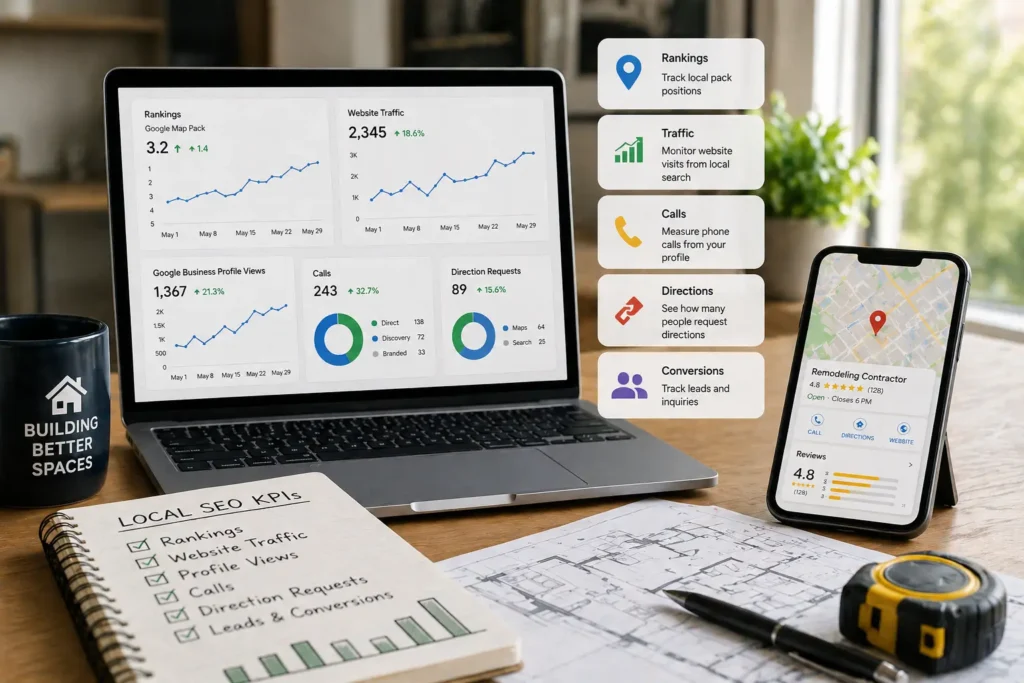
Local SEO is a long game. You need data to know if it’s working.
Google Search Console shows you which search terms bring people to your site, how often you appear in results, and how many people click through.
Google Analytics shows what visitors do once they land on your site, which pages they read, how long they stay, and whether they contact you.
GBP Insights shows how many people called your business, requested directions, or clicked to your website directly from your profile.
Rank tracking tools like BrightLocal or Whitespark let you see where your business ranks for specific search terms, broken down by zip code or city.
Check these metrics once a month. Local SEO results shift slowly. Month-over-month trends tell a more honest story than day-to-day changes.
FAQs
How long does local SEO take to show results?
Most remodeling businesses start seeing movement within three to six months. The timeline depends on your market size and how competitive your area is. Consistency speeds things up.
Do I need a website, or is a Google Business Profile enough?
Your GBP can get you into the local pack on its own. But a website gives you far more surface area, more pages, more keywords, more chances to rank. Both together is the stronger setup.
What’s the difference between local SEO and regular SEO?
Regular SEO targets broad or national audiences. Local SEO targets people searching in a specific location. For remodeling contractors, local search is almost always the right priority.
How many Google reviews do I need?
There’s no magic number. Businesses in the local pack often have 30 to 100+ reviews. Focus on getting a steady flow rather than a one-time batch. Recency matters as much as quantity.
Should I hire an SEO agency or handle this myself?
You can manage the basics yourself, especially your GBP and review collection. Technical on-page work and citation building are more time-consuming. An agency can speed up results in competitive markets, but self-managing is a real option if you’re consistent.
Does my social media presence affect local SEO? Not directly. Social media doesn’t carry much weight in Google’s local ranking algorithm. That said, active social profiles can drive traffic to your website, which may help over time.
What if a competitor leaves fake negative reviews on my profile? Flag the review through Google for removal. While you wait, reply calmly and professionally. Google does review flagged content and removes posts that break its policies.
Conclusion
Local SEO for your remodeling business comes down to a few core actions: a complete and active Google Business Profile, location-specific pages on your website, consistent directory listings, and a regular stream of real customer reviews.
None of these is complicated. But they do require steady effort over time.
The contractors who show up at the top of local search results aren’t necessarily the best in their market. They’re often just the most consistent online.
Want to see where your business stands?
Get a free local SEO audit and find out exactly what’s holding your remodeling company back from page one.
