

You know that feeling when your phone rings and it’s a homeowner ready to talk about a $50,000 kitchen remodel?
They found you on Google. They already checked your reviews. They’ve seen your work. Now they just want to know when you can start.
That’s what good local SEO does. It puts you in front of people who are already looking for exactly what you offer.
The remodeling industry hit $503 billion in 2024, according to RubyHome. Even with the housing market cooling off, homeowners are still spending money on upgrades.
The question isn’t whether there’s demand. The question is whether those homeowners can find you before they find your competitor down the street.
This guide breaks down how local SEO actually impacts your bottom line. We’ll cover the numbers, the strategies that work, the mistakes that kill your visibility, and what homeowners are really looking for when they search for a remodeler.
Table of Contents
Why Local SEO Matters More Than Ever for Remodelers
Here’s a stat that might surprise you: 97% of consumers check a business’s online presence before making contact, according to RGC Digital Marketing.
That includes referrals. Even when someone’s neighbor recommends you, they’re still going to Google your name before picking up the phone.
Word of mouth isn’t dead. But it’s not enough anymore. Your digital presence is the first impression for almost every potential client.
The Numbers Behind Local Search
Nearly half of all Google searches have local intent. RGC Digital Marketing reports that 46% of searches are people looking for something in their immediate area. For remodelers, that percentage is probably even higher.
Think about it. Nobody searches “kitchen remodeler” hoping to find someone three states away. They want local. They want nearby. They want someone who can actually show up.
And here’s where it gets interesting. Invoca and ComScore found that 78% of local mobile searches result in an offline purchase or contract within 24 hours. These aren’t tire-kickers. These are people ready to hire.
The Cost Difference That Should Get Your Attention
Customer acquisition cost · Construction industry 2025
SEO gets you
more clients for
less money.
Loopex Digital’s 2025 analysis of construction industry marketing revealed a stark gap between organic and paid customer acquisition costs. Here’s what the numbers say.
Cost per customer
Lower upfront investment.
Compounds over time.
Cost per customer
Fast results. But costs
reset when you stop.
For every $1,000 spent on paid ads, you could acquire the same customers through SEO for just $436 — freeing up $564 to reinvest. SEO takes time to build, but the leads it generates don’t stop when your budget does.
Source: Loopex Digital, Construction Industry Marketing Report 2025
Let’s talk money. Loopex Digital compared customer acquisition costs across different channels for the construction industry in 2025. The results:
- Organic search (SEO): $212 per customer
- Paid advertising: $486 per customer
That’s a 56% cost difference. For every two customers you acquire through paid ads, you could have gotten almost five through organic search for the same budget.
Now, SEO takes time. Paid ads can work faster. But if you’re playing the long game (and you should be), building your local search presence is one of the smartest investments you can make.
How Local SEO Actually Works for Remodeling Companies
Local SEO isn’t magic. It’s a system. When you understand the pieces, you can start putting them together.
The Local 3-Pack: Your Most Valuable Real Estate
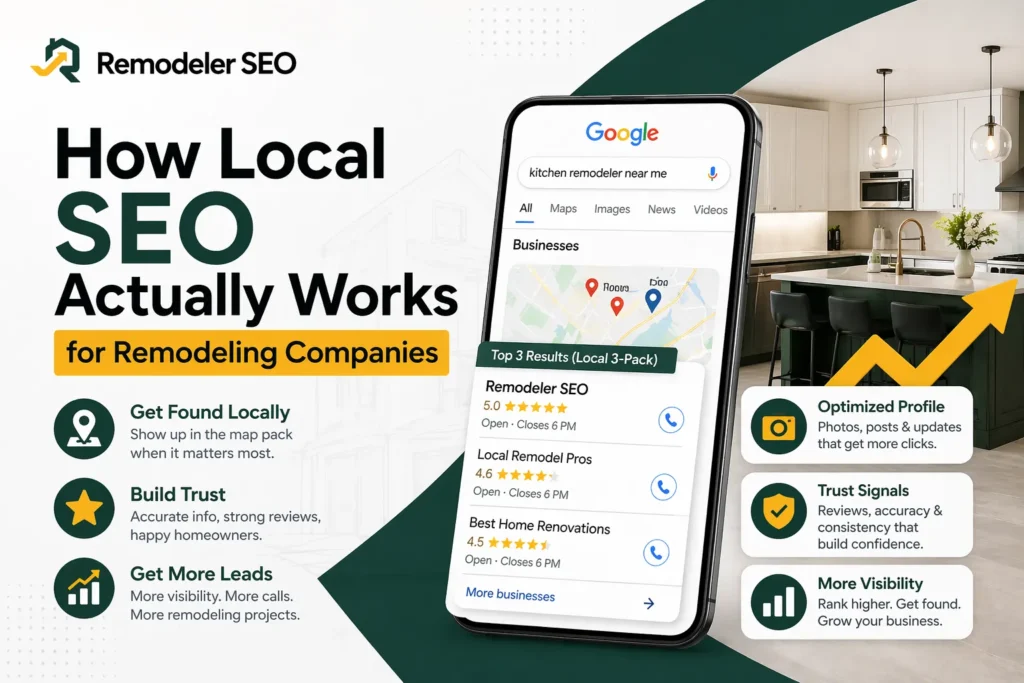
When someone searches “kitchen remodeler near me,” Google shows a map with three businesses underneath. That’s the Local 3-Pack, sometimes called the Map Pack.
According to Moz and Loopex Digital, those top three results capture 44% of all clicks. If you’re not in that box, you’re missing nearly half of your potential traffic.
Getting into the 3-Pack isn’t random. Google looks at three main factors:
Relevance: Does your business match what the person is searching for?
Distance: How close are you to the searcher?
Prominence: How well-known and trusted is your business online?
You can’t control distance. But you can control relevance and prominence. That’s where local SEO strategy comes in.
Google Business Profile: Your Digital Storefront
Here’s something that might change how you think about your website. According to data from Google and Loopex Digital, 42% of local searchers find what they need directly on the search results page. They get your phone number, your hours, your reviews without ever clicking through to your site.
Your Google Business Profile (GBP) isn’t just a listing. For many potential clients, it IS your homepage.
Listings with frequently updated photos receive 35% more website clicks and 42% more requests for directions, according to Google and Loopex. That’s not a small bump. That’s a significant competitive advantage from something as simple as uploading project photos regularly.
The Trust Signals That Close Deals
BrightLocal found that 80% of people lose trust in a business when they find inaccurate information online. Wrong phone number. Old address. Inconsistent business name. Any of these can kill your close rate before you ever talk to the homeowner.
This is called NAP consistency: Name, Address, Phone number. It sounds basic because it is. But it’s one of the most common problems we see with remodeling companies.
The Data That Should Shape Your Strategy
Let’s look at the numbers that matter most for remodelers in 2025.
| Metric | What It Means | Source |
| 46% of searches are local | Nearly half your potential traffic is looking for local services | RGC Digital Marketing, 2024 |
| 78% of mobile local searches lead to purchase | Mobile searchers have extremely high intent | Invoca/ComScore, 2024 |
| $212 organic CAC vs $486 paid CAC | SEO costs 56% less per customer than paid ads | Loopex Digital, 2025 |
| 44% CTR for Local 3-Pack | Top 3 map results get nearly half of all clicks | Moz/Loopex, 2025 |
| 35% more clicks with GBP photos | Regular photo uploads significantly boost engagement | Google/Loopex, 2025 |
| 40% bounce rate for slow sites | Mobile sites over 3 seconds lose 40%+ of visitors | Contractor Accelerator, 2025 |
| 42% of homeowners compare only 2 quotes | Being found first gives you a major advantage | Modernize, 2024 |
| 120% increase in map impressions | Professional local SEO management more than doubles visibility | Rocket PPC, 2024 |
That last stat deserves attention. Rocket PPC found that professional local SEO management led to a 120% increase in map impressions across multiple home service clients. That’s more than doubling the number of eyes on your business.
The Speed-to-Lead Factor
Here’s where operations and marketing collide. Hatch and Harvard Business Review analyzed lead response times across industries. Their finding: contractors who contact a lead within 5 minutes are 21 times more likely to qualify that lead than those who wait 30 minutes.
Twenty-one times. Not 21 percent. Twenty-one times.
All the SEO in the world won’t help if leads sit in your inbox. As one TDSGS analysis put it: “A fast response increases the chances of lead conversion…before they lose interest.”
Your local SEO gets the phone to ring. Your response time determines whether that call becomes a contract.
What Homeowners Are Really Saying

We dug into Reddit threads, Houzz forums, and review platforms to understand what homeowners actually experience when hiring remodelers. These patterns show up again and again.
The Top Complaints
Communication breakdowns. Homeowners repeatedly mention contractors who “ghost” them after taking a deposit or during the punch list phase. Daily updates matter more than most contractors realize.
Timeline confusion. Projects scheduled for 4 weeks that turn into 4 months. No explanation. No updated schedule. Just frustration.
Dust and mess. This one surprised us. Forum posts show that dust management is a top-three reason for negative reviews. According to Houzz data, 68% of homeowners are displeased with how contractors handle dust.
Price surprises. Initial low-ball bids that spiral with “unforeseen” costs. Homeowners call this bait-and-switch, and it shows up constantly in negative reviews.
Vague contracts. Contracts that don’t specify materials, exact products, or project milestones create anxiety and conflict.
What Gets Praised
Daily communication. Texts or app updates showing progress. Letting homeowners know what’s happening without them having to ask.
Fixed pricing. Firm quotes rather than “preliminary estimates.” Homeowners want to know the real number upfront.
Clean job sites. Sites that are swept and organized at the end of every work day. This gets mentioned in positive reviews more than almost anything else.
Local proof. Showing project photos from the same neighborhood or nearby streets. Homeowners love seeing that you’ve worked in their area.
The punch list promise. Contractors who stay until the very last 1% is perfect. Not rushing out after the “big stuff” is done.
One Reddit thread in r/remodeling noted that couples who survive major renovations are those who had “communicative” contractors. According to Houzz, 12% of couples consider divorce during a remodel. Your communication skills aren’t just good customer service. They might be saving marriages.
Common Mistakes That Kill Your Local SEO
These are the errors we see most often. Fixing them can move the needle fast.
Mistake 1: Inconsistent Business Information
Your business name is “Smith Home Remodeling” on Google but “Smith Remodeling LLC” on Yelp and “Smith Home Improvement” on your Facebook page. Google sees these as three different businesses. Your authority gets split.
Pick one name. Use it everywhere. Same with your address and phone number.
Mistake 2: Ignoring Your Google Business Profile
Some remodelers set up their GBP once and never touch it again. They’re leaving money on the table.
Upload 3-5 new project photos every week. Respond to reviews. Post updates about completed projects. Active profiles rank higher.
Mistake 3: Targeting Too Broad
“Kitchen remodeler Chicago” is competitive. “Kitchen remodeler Lincoln Park” is less competitive and more specific.
Create landing pages for individual neighborhoods you serve. Hyperlocal targeting is the dominant trend for 2025, and it works because it matches how people actually search.
Mistake 4: Slow Website on Mobile
BrightLocal reports that 56% of home service searches happen on smartphones. Contractor Accelerator found that any website taking more than 3 seconds to load sees a bounce rate of 40% or higher.
Test your site on your phone. If your portfolio page takes forever to load, you’re losing leads.
Mistake 5: Not Asking for Specific Reviews
Generic reviews help. Specific reviews help more.
According to NOVA Ad, Google’s AI now analyzes review content to understand what customers are saying. When clients mention specific services like “quartz countertops” or “custom cabinetry,” it reinforces your expertise for those terms.
Ask happy clients to mention the specific work you did for them.
Mistake 6: Thinking SEO Is a One-Time Setup
Google’s 2025 algorithm updates shifted the focus toward fresh, authentic content. Firms that “set it and forget it” see a 14-20% traffic drop annually, according to industry analysis.
SEO is maintenance, not installation.
Best Practices: Your Local SEO Playbook
Here’s what’s working for remodeling companies right now.
Google Business Profile Optimization
- Upload 3-5 new project photos per week
- Respond to every review (positive and negative)
- Use the Q&A feature to answer common questions
- Post updates about completed projects
- Make sure your service categories match what you actually do
Website Fundamentals
- Page load time under 2.5 seconds on mobile
- Clear click-to-call buttons (166 out of 392 leads in one case study came from click-to-call, per Online Visibility Pros)
- Before/after galleries with location tags
- Service pages for each type of work you do
- Location pages for each neighborhood you serve
Content That Builds Trust
- Project stories with photos and details
- FAQ pages that answer common homeowner questions
- Pricing guides that set realistic expectations
- Process explanations that reduce anxiety
As Greg Gifford noted in BrightLocal’s 2025 Expert Predictions: “Foundational SEO tasks will be more important since so many are using AI to optimize page elements.”
The basics matter more than ever because everyone’s trying to automate the shortcuts.
Review Strategy
- Ask for reviews at project milestones (not just at the end)
- Make it easy with a direct link
- Suggest they mention the specific work you did
- Respond to every review within 24 hours
Tim Capper, in the same BrightLocal report, put it simply: “People want to see the businesses as local and support local.”
Quick Checklist: Local SEO for Remodelers
Copy this and use it.
Google Business Profile
- Business name matches exactly across all platforms
- Address is complete and accurate
- Phone number is consistent everywhere online
- Service categories are correct and complete
- 50+ photos uploaded (add more weekly)
- All reviews have responses
- Q&A section is populated with common questions
Website
- Loads in under 3 seconds on mobile
- Click-to-call button visible on mobile
- Service pages for each offering
- Location pages for each area served
- Before/after project gallery
- Contact form works and notifies you immediately
- SSL certificate installed (https)
Reviews
- System in place to request reviews after projects
- Response template ready for positive reviews
- Response template ready for negative reviews
- Monitoring set up for new reviews
Content
- Homepage clearly states what you do and where
- About page includes team photos and credentials
- Process page explains what clients can expect
- FAQ page answers common questions
Operations
- Lead response system in place (goal: under 5 minutes)
- Someone assigned to answer during business hours
- After-hours voicemail mentions callback timeframe
The Bottom Line on Local SEO ROI
The numbers tell a clear story.
According to The HOTH’s analysis: “SEO is the #1 marketing channel for lead conversion…which converts leads at a high rate of 14.6%.”
Compare that to the constant spend of paid ads, the low-quality leads from aggregator sites, and the unpredictability of referrals. Local SEO takes longer to build, but it creates an asset that keeps working for you.
One industry report from Burning River summarized it well: “Local SEO isn’t just a trend—it’s a long-term investment in your business’s discoverability and growth.”
FAQs About Local SEO for Remodeling Companies
How long does local SEO take to show results?
Most remodelers see meaningful movement in 3-6 months. Full results typically take 6-12 months. It’s slower than paid ads but more sustainable and cost-effective long-term.
Is local SEO worth it for a small remodeling company?
Yes. In fact, local SEO often works better for smaller companies because you can dominate specific neighborhoods rather than competing across entire metro areas. The hyperlocal approach gives smaller firms an advantage.
What’s more important: my website or my Google Business Profile?
Both matter, but your GBP may actually reach more people. Data shows 42% of local searchers find what they need without clicking through to a website. Your GBP is often the first (and sometimes only) impression.
How many reviews do I need?
More is better, but quality and recency matter too. A business with 50 reviews from the past year typically outranks one with 200 reviews from five years ago. Focus on consistent new reviews rather than a single big push.
Do I need to blog to rank in local search?
Blogging helps but isn’t required for local pack rankings. Your GBP optimization, reviews, and NAP consistency matter more for map results. Blogging helps more for regular organic search results.
Can I do local SEO myself?
Yes. The fundamentals are straightforward. Claim your GBP, keep your information consistent, upload photos, get reviews, respond to them. Where it gets complex is competitive analysis, technical issues, and scaling across multiple service areas.
What’s the biggest local SEO mistake remodelers make?
Inconsistent business information across the web. It confuses Google and erodes trust with potential clients. Audit your listings on Google, Yelp, Facebook, Angi, Houzz, and anywhere else you appear.
How do I compete with bigger companies in local search?
Target specific neighborhoods instead of broad metro areas. A large company might own “Dallas kitchen remodeler” but you can own “Highland Park kitchen remodeler.” Hyperlocal beats broad when you’re smaller.
Should I hire someone for local SEO or do it in-house?
It depends on your time and expertise. The basics can be handled in-house with a few hours per week. More advanced strategy, technical fixes, and competitive markets often benefit from professional help.
Does social media affect my local SEO rankings?
Social signals (likes, shares) are not direct ranking factors. But social media traffic to your site can improve user engagement metrics, which indirectly helps SEO. Social is better viewed as a complement to SEO, not a replacement.
What’s Your Next Step?
Local SEO isn’t complicated. But it does require consistent effort.
You have two paths forward:
Do It Yourself:
- Audit your Google Business Profile this week
- Fix any NAP inconsistencies across the web
- Upload 5 new project photos to your GBP
- Set up a system to request reviews after every project
- Test your website speed on mobile
Get Help: At RemodelerSEO, we’ve spent 5 years helping remodeling companies build their local search presence. If you want a second set of eyes on your current setup, we offer a free local SEO audit for remodelers.
No pressure. No pitch. Just a clear picture of where you stand and what you could improve.
Either way, the market is there. Homeowners are searching. The only question is whether they’ll find you or find your competitor first.
