

If you run a contracting business and your phone isn’t ringing enough, local citations for contractors might be the problem. Most contractors spend money on flyers, truck wraps, and word-of-mouth. But when a homeowner searches “plumber near me” or “roofer in [city],” citations decide who shows up. Not the guy with the nicest van.
This guide breaks down what citations are, why they matter, and how to build them the right way.
What Are Local Citations?
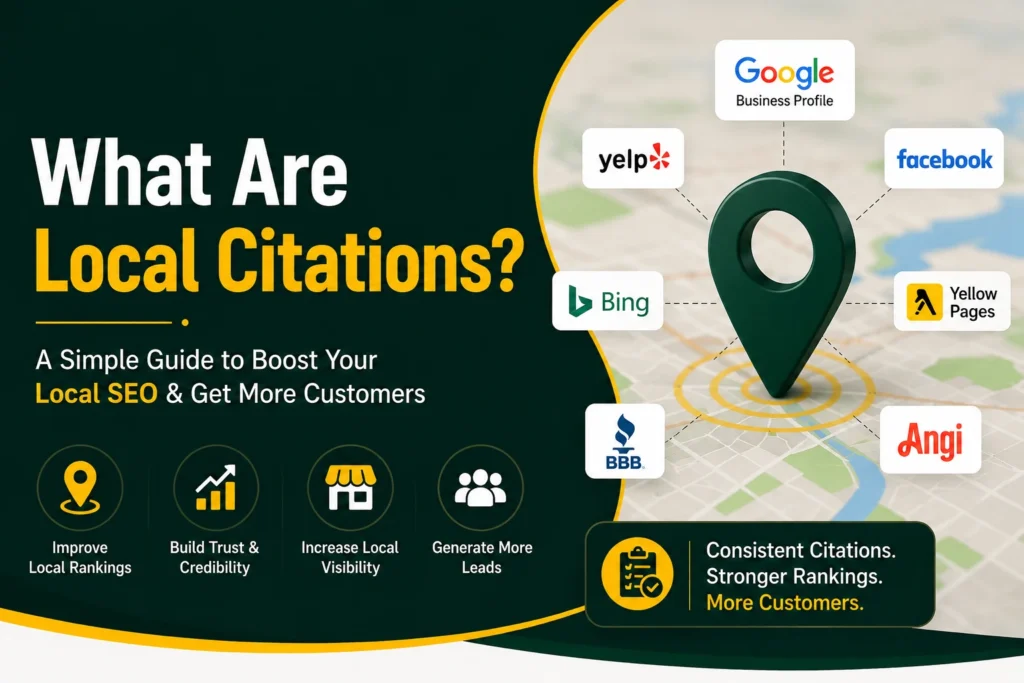
A local citation is any place online that lists your business name, address, and phone number. That’s it. Simple as that.
These three pieces of info – name, address, phone number are called NAP. You’ll hear that term a lot in local SEO circles. Google uses your NAP data to confirm your business is real and that it operates where you say it does.
Citations show up in directories like Yelp, Angi, and the Better Business Bureau. They also appear on local chamber of commerce websites, news articles, and industry platforms. Some list your full details. Others just mention your business name with a link. Both count.
For contractors, citation directories are one of the first places Google looks when deciding who ranks in the map section. If your listings are wrong, inconsistent, or missing, your rankings suffer. Its that direct.
NAP consistency is one of the most basic ranking signals for local SEO. Yet a lot of contractors get it wrong without knowing it.
Why Local Citations Matter for Contractors
You Show Up When It Counts
When someone needs a contractor, they search on Google. Most of them click one of the top three results in the map pack, those business listings that appear above the regular search results. Citations are a big part of how Google decides who goes in that map pack.
The more places your business appears with accurate information, the more Google trusts you. More trust means better rankings. Better rankings mean more calls.
They Build Online Trust Fast
Homeowners don’t just search, they check. If someone finds your business on Google, they’ll often look you up on Yelp, Angi, or Facebook before calling. If your listings look incomplete or your phone number is different on each site, they move on. Someone else gets the job.
Consistent citations make you look established and professional. Even if your website isn’t great yet, solid listings across trusted directories can make a real difference.
You Get Found on Multiple Platforms
Google isn’t the only place people search. Plenty of homeowners go straight to Houzz, Thumbtack, or Angi when they’re looking for a contractor. Having complete profiles on those platforms puts you in front of people who might never find you through Google at all.
More platforms, more exposure. Its simple math.
Competitive Advantage in Local Search
A lot of contractors in your area probably haven’t touched their citations in years, if they’ve ever built them at all. Thats an opportunity. A clean, consistent citation profile can push you above competitors who’ve been in business longer but haven’t bothered with their online presence.
Types of Local Citations
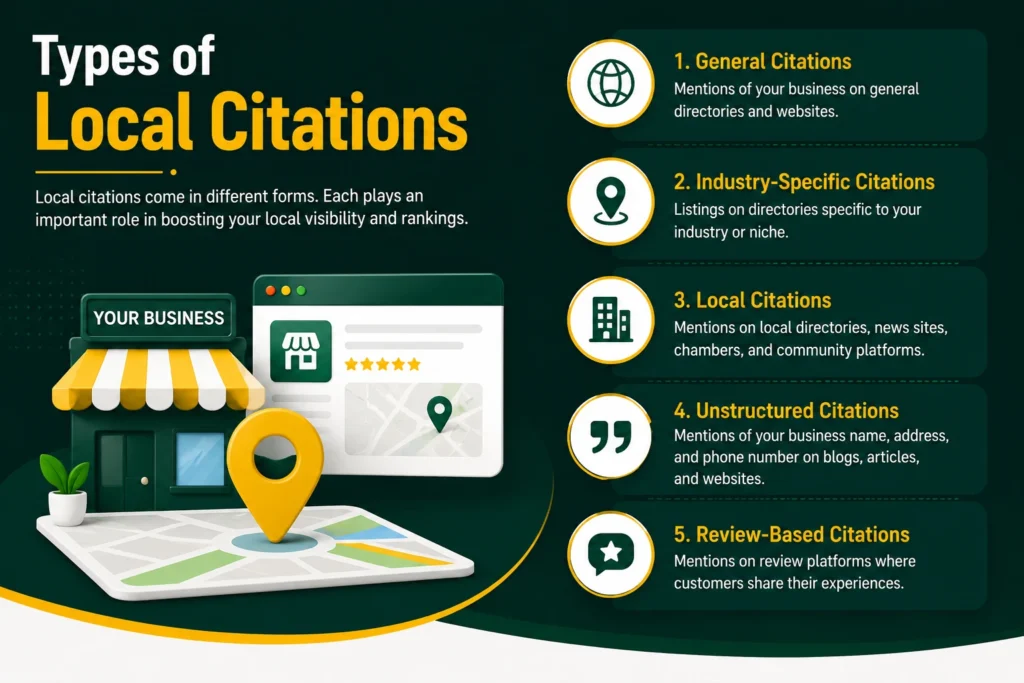
Not all citations are the same. Knowing the difference helps you build a better strategy.
Structured Citations
These are formal directory listings where your NAP sits in a specific spot. Sites like Yelp, Google Business Profile, and Angi all count as structured citations. They have a set format: name, address, phone, maybe a description and some photos.
Structured citations carry the most weight for local rankings because Google can read them clearly and confirm the details.
Unstructured Citations
These are mentions of your business in places that aren’t directories. A local news article that names your business. A blog post that recommends you. A community Facebook group where someone tags your company. These don’t follow a set format, but they still count.
Unstructured citations add credibility in a different way. They signal that real people and real publications are talking about your business.
Industry Directories
These are platforms built specifically for contractors and home services. Sites like Houzz, Angi, Thumbtack, and HomeAdvisor fall in this category. They’re not just citation sources. They often send you direct leads too.
Getting listed on these matters for both citations and lead gen. Two birds, one stone.
Data Aggregators
Data aggregators are companies that collect and distribute business information across hundreds of directories and apps. The main ones in the US are Data Axle, Neustar Localeze, and Foursquare. When you update your info with an aggregator, it can spread to dozens of smaller sites automatically.
If your NAP has ever been wrong anywhere online, there’s a good chance an aggregator is still spreading the old version. That’s worth fixing.
Local Directories
Local chambers of commerce, city business directories, and regional news sites often list local businesses. These carry strong geographic relevance signals for Google. A citation from your local chamber tells Google you’re a legitimate business rooted in that specific area.
Best Citation Sites for Contractors
Here are the platforms you should be listed on. Start here before anything else.
General Directories (High Priority)
- Google Business Profile – the most important one. Full stop.
- Bing Places for Business – Bing has more users than most people think.
- Facebook Business Page – treated as a citation source by Google.
- Yelp – high authority, especially for home services.
- Better Business Bureau – strong trust signal, even if fewer people use it to find contractors directly.
- Apple Maps – important for iPhone users who never open Google.
Contractor-Specific Directories
- Angi (formerly Angie’s List) – one of the most visited home services platforms.
- HomeAdvisor – part of the same company as Angi, still worth separate listings.
- Houzz – strong for remodelers, designers, and kitchen or bath contractors.
- Thumbtack – lets customers contact you directly through the platform.
- Porch – a growing platform for home services.
- BuildZoom – pulls contractor license data and builds profiles automatically, worth claiming.
- Networx – smaller but still sends traffic in some markets.
Review and Trust Platforms
- Trustpilot – gaining traction in the US.
- Expertise.com – ranks contractors by specialty in specific cities.
- Bark.com – popular for service businesses.
Local and Regional
- Your local chamber of commerce directory
- City or county business directories
- Regional news sites that list local businesses
- Neighborhood apps like Nextdoor (claim your business page)
You don’t need to be everywhere. Get the high-authority directories right first. Then add local and niche ones over time.
How to Build Local Citations Correctly
Getting listed is just step one. How you build those listings matters just as much.
Get Your NAP Right and Keep It Consistent
This is the most important rule. Your business name, address, and phone number must be exactly the same on every platform. Not similar. Exact.
If your Google listing says “Smith Roofing LLC” but Yelp says “Smith Roofing,” that inconsistency sends mixed signals to Google. If one site has your old phone number and another has the new one, that’s a problem.
Before you build any new citations, write down your exact NAP. Use that version everywhere. Copy and paste it. Don’t type it from memory each time.
Write a Strong Business Description
Most directories let you add a business description. Use it. Don’t just write one or two sentences about being a local contractor. Tell people what you do, where you work, and why someone should call you over the next guy.
Include your primary services and the cities or areas you cover. Use natural language. Avoid stuffing in too many keywords. The description should read like something a real person wrote.
Pick the Right Categories
Every directory lets you choose a business category. Pick the one that best matches your primary service. If you’re a plumber, select plumbing. If you’re a general contractor who also does roofing, pick the category that drives the most of your work.
Wrong categories confuse both Google and potential customers. Don’t list yourself as a landscaper if you’re primarily a deck builder.
Add Photos
Listings with photos get more clicks. Add real photos of your work, your truck, your team. Not stock images. Real ones.
A before-and-after of a recent job does more for your listing than a logo and blank profile. Customers want to see what you can actually do.
Get Reviews Early
Reviews aren’t technically citations, but they go hand-in-hand. Listings with strong review counts perform better in search and convert better when customers land on them.
Ask every happy customer to leave a review. Make it easy by sending them a direct link.
Clean Up Duplicate Listings
Duplicate listings confuse Google and split your credibility across multiple profiles. If your business shows up twice on the same directory, that’s a problem. Find duplicates by searching your business name and phone number across platforms. Then either merge, delete, or suppress the extras.
Common Citation Mistakes Contractors Make
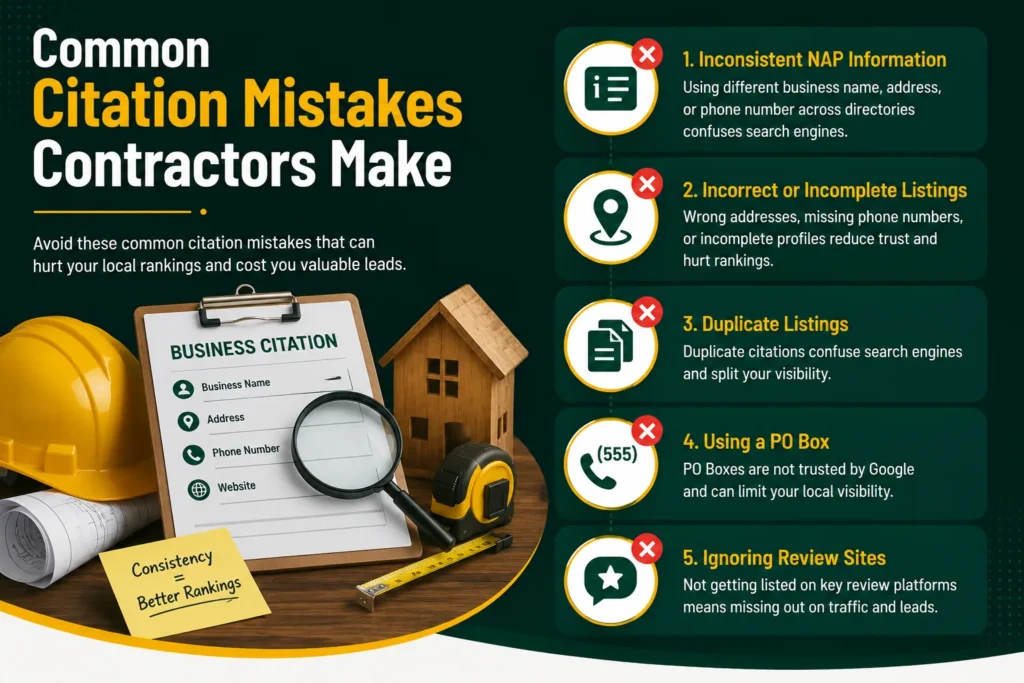
Most contractors make the same few mistakes. Here’s what to watch for.
Inconsistent NAP
Already mentioned above, but it deserves its own spot. This is the number one citation mistake. Using different phone numbers on different sites, or listing your address differently from place to place, kills your local rankings.
Check every major listing and make sure the details match exactly.
Ignoring Duplicates
Some contractors have three or four listings on the same directory. This happens when a business moves, changes its number, or gets auto-generated profiles by directories. Duplicates split your credibility and make it hard for Google to know which version is correct.
Find them and deal with them. Leaving duplicates live is worse than having no listing at all.
Wrong or Irrelevant Categories
Choosing the wrong category is a common error that goes unnoticed for months. A roofing contractor listed under “construction company” isn’t showing up when someone searches for a roofer. Category selection directly impacts what searches your listing appears for.
Incomplete Profiles
A lot of contractors set up a basic listing and leave it half-finished. No description. No photos. No hours. Incomplete profiles don’t rank well. They also don’t convert. Customers see an empty-looking listing and assume the business isn’t active.
Fill out every field the directory offers.
Ignoring Outdated Information
You moved your office. Changed your number. Added a new service area. Did you update your citations? Most contractors don’t. Outdated info on directories sends customers to the wrong address and calls to a dead number. That’s a real cost.
Set a reminder to audit your top listings twice a year.
Not Responding to Reviews
Not a citation issue exactly, but it hurts your listings. Customers see how you respond (or don’t respond) to reviews. Ignoring negative ones tells prospects you don’t care. Even a brief, professional reply can turn a bad review into a trust signal.
Local Citations vs Backlinks: What’s the Difference?
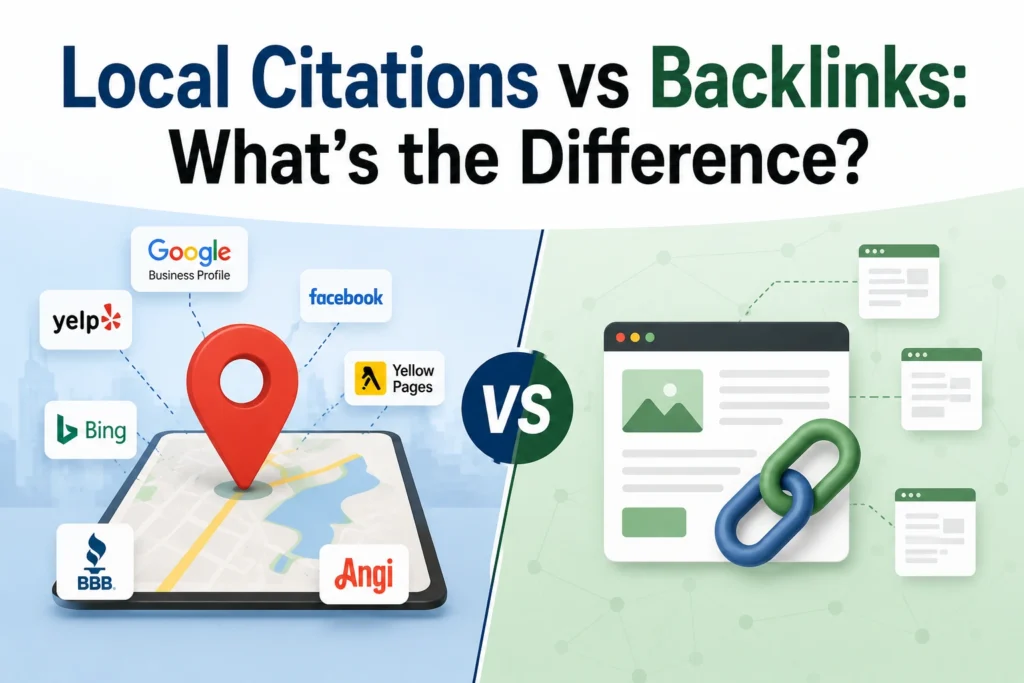
People sometimes confuse citations with backlinks. They’re related but not the same.
A backlink is when another website links to yours. It’s a ranking signal that tells Google your site is worth pointing people to. Backlinks carry a lot of weight in traditional SEO.
A citation is a mention of your business NAP. It may or may not include a link to your website. The mention itself is the signal, not necessarily the link.
For local SEO, citations and backlinks both matter. But they work differently. Citations build local trust and geographic relevance. Backlinks build overall domain authority.
Think of citations as telling Google “this business is real and operates in this area.” Think of backlinks as telling Google “this website is trustworthy and worth showing in search results.”
You need both. But for contractors trying to rank in a specific city or neighborhood, citations are often the faster win.
Ready to Fix Your Local Citations?
If you’ve been ignoring your citations, you’re probably losing jobs to competitors who haven’t done much more than keep their listings clean and consistent.
Getting your citations right doesn’t require a huge budget. It requires attention to detail and a bit of time. But if you’d rather not spend hours tracking down listings, cleaning up duplicates, and managing profiles across 50 directories, that’s what we’re here for.
We offer a free local SEO audit for contractors. We’ll show you exactly where your citations stand right now, where the gaps are, and what fixing them could do for your rankings.
Book your free audit today and find out how many leads your citations are costing you.
