
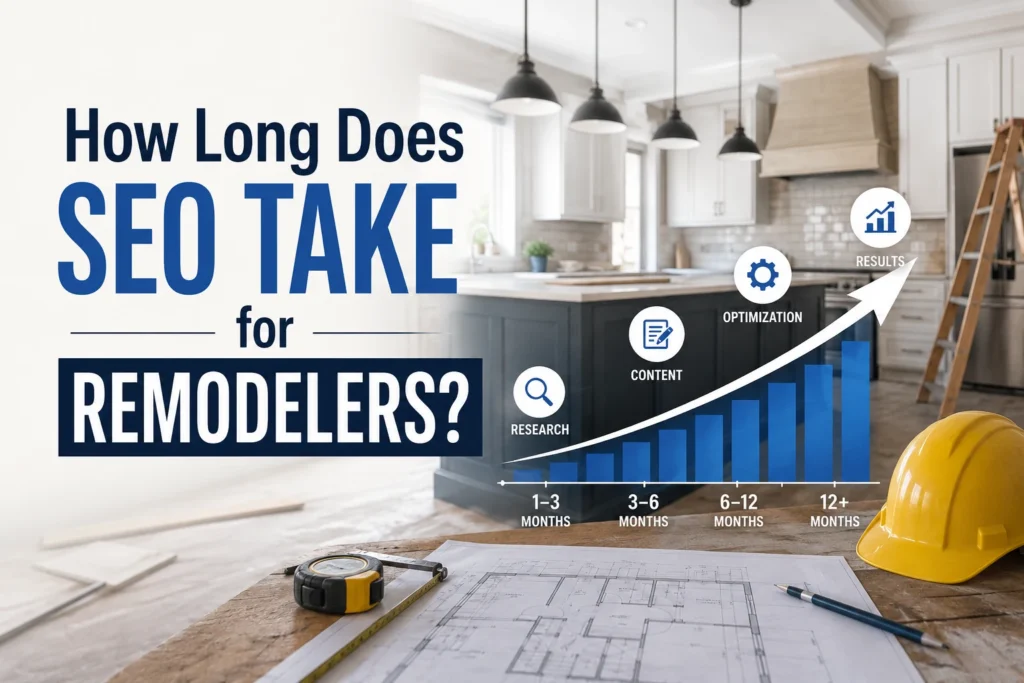

If you’ve ever typed “how long does SEO take” into Google, you probably got a lot of vague answers. Six months. Twelve months. It depends.
And honestly? All of those answers are kind of right. But none of them tell you why. Or what you can do about it.
So let’s fix that. This post breaks down how long SEO actually takes for remodeling businesses, what’s happening behind the scenes, and what you can do to get results faster.
The Honest Answer Nobody Likes
Here it is: most remodelers start seeing real SEO results between 3 and 6 months.
Some see movement earlier. Some take longer. A brand new website with zero history can take up to 12 months before things really click.
That’s not a cop-out. It’s just how Google works.
Think of it like planting grass seed. You can water it every day and do everything right, but you still have to wait for it to grow. There’s no shortcut around the waiting period. You can speed it up a little, but you can’t skip it entirely.
The good news? Once it grows in, it stays. Unlike paid ads, which stop the moment you stop paying, SEO keeps working in the background.
Why Does SEO Take So Long for Remodelers?

Google doesn’t trust websites it just met. That sounds strange, but it’s true.
When a remodeling company launches a new site or starts doing SEO for the first time, Google has to figure out a few things:
- Is this a real business?
- Is this website worth showing to people?
- Does this site actually answer what people are searching for?
That process takes time. Google crawls your site, indexes your pages, checks your backlinks, looks at how people interact with your content, and then decides where to rank you.
For established remodeling companies with an older domain and some existing content, this process is faster. For brand new websites, it takes longer because Google has no prior history to go on.
One SEO manager put it well: results are “lasting and permanent” once they come in, and they don’t need ad spend to maintain them. That’s the trade-off. You wait now, but you save money long-term.
What Happens in the First Few Months
Here’s a rough idea of what to expect when you start doing SEO for a remodeling business:
Months 1 to 2: Not much visible change. Google is crawling your site and figuring out what it’s about. Your keyword rankings might jump around a bit. This is normal, especially for newer sites.
Months 3 to 4: You start seeing some early movement. A few keywords begin ranking on page two or three. Traffic starts to tick up slightly. This is a good sign things are working.
Months 5 to 6: This is usually when things start feeling real. Traffic climbs more steadily. You might start getting calls from people who found you through Google. Your best pages begin ranking on page one for local searches.
Beyond 6 months: Growth compounds. Pages that were ranking number eight slowly move to number three. New content builds on what’s already working. Results become more consistent.
This is not a straight line. There will be weeks where rankings dip and weeks where they spike. That’s just how it goes.
New Website vs. Existing Website: Does It Matter?

Yes. A lot.
If your remodeling company has had a website for a few years, even if you’ve done nothing with it, Google already knows it exists. It has some history. That gives you a head start.
If you’re starting with a brand new domain, you’re starting from zero. Google doesn’t know who you are, whether you’re a real business, or whether your site has anything worth showing people. You’ll need to earn that trust first.
One clear pattern shows up again and again: websites that already exist tend to see SEO results faster than brand new ones. Older sites have an advantage just from being around longer.
That’s why people pay more for aged domains. The SEO history is already there.
If you’re starting fresh, that’s fine. It just means you need to be patient for the first few months while Google gets to know your site.
What Speeds Up SEO for Remodeling Companies
You can’t rush Google. But you can do things that make the process move faster.
1. Publish More Content, Faster
One of the biggest factors in how quickly your site ranks is how much quality content you have.
A remodeling website with five pages gives Google very little to work with. A site with 30 pages covering kitchen remodels, bathroom renovations, basement finishing, local service areas, and common customer questions gives Google a lot more to index and rank.
The more relevant content you publish, the faster Google understands what your site is about. And the faster it can start ranking you.
This doesn’t mean writing rubbish just to hit a number. The content has to actually answer what your customers are searching for. Think about the questions homeowners ask before hiring a remodeler:
- How much does a kitchen remodel cost?
- How long does a bathroom renovation take?
- Do I need a permit for a home addition?
- What should I look for in a remodeling contractor?
Write good answers to those questions. That’s content that ranks and converts.
2. Get Backlinks from Real Websites
A backlink is when another website links to yours. Google treats these as votes of confidence.
If a local news site, a home improvement blog, or a supplier’s website links to your remodeling business, Google sees that as proof you’re legitimate. It speeds up the trust-building process.
The quality of backlinks matters more than the quantity. One link from a well-known local business directory is worth more than ten links from random irrelevant sites.
Good places to start:
- Local business directories (Google Business Profile, Houzz, Angi, HomeAdvisor)
- Your local chamber of commerce
- Suppliers or manufacturers you work with
- Any local news coverage or press
Even 20 to 30 solid citations can make a noticeable difference in how fast your site gets indexed and trusted.
3. Sort Out Your Technical SEO
Sometimes the reason SEO isn’t working has nothing to do with content or links. It’s a technical problem.
Common issues that hold remodeling websites back:
- Page titles that just say “Home” or “Services” instead of something descriptive
- Slow loading speeds
- Pages that aren’t indexed by Google at all
- No proper headings or structure on pages
- A site that doesn’t work well on mobile
If your page title for your kitchen remodeling page says “Services,” you’re making Google guess. Change it to “Kitchen Remodeling in [Your City] | [Your Company Name]” and you’ll likely see movement within weeks.
Technical fixes are often the fastest wins in SEO. They don’t require new content. They just require fixing what’s already broken.
4. Submit Your Site to Google Search Console
This is free and takes about 10 minutes.
Google Search Console lets you submit your sitemap, which tells Google all the pages on your site. It also lets you request indexing for specific pages, which nudges Google to crawl them faster.
When you publish a new page about bathroom remodeling in your area, go into Search Console and request indexing. It won’t guarantee overnight results, but it does speed up how quickly Google finds and processes the page.
What If You’ve Been Doing SEO for Months and Nothing’s Happening?
First, check how long you’ve actually been doing it. Three months can feel like forever when you’re not seeing results. But three months is still early.
If you’re past the six-month mark and genuinely seeing nothing, here are the likely culprits:
Your content isn’t targeting the right keywords. If you’re writing about general home improvement topics instead of remodeling services in your specific area, you’re competing nationally against massive sites. Go local. Target your city, your neighbourhoods, your service areas.
Your pages aren’t being indexed. Go into Google Search Console and check. If your pages aren’t indexed, Google can’t rank them. This is more common than people think.
Your site has technical issues Google doesn’t like. Slow load times, broken links, duplicate content, and thin pages all signal to Google that your site isn’t great. These things need to be fixed before rankings will improve.
You’re in a competitive market. Some cities have dozens of well-established remodeling companies all doing SEO. Breaking through takes longer. This doesn’t mean SEO won’t work. It just means you need to be more strategic and patient.
The Remodeling SEO Timeline in Plain English
Let’s make this simple:
| Timeframe | What to Expect |
| Month 1–2 | Google crawls and indexes your site. Rankings start forming. No real traffic yet. |
| Month 3–4 | Some keywords ranking on page 2–3. Small traffic increase. |
| Month 5–6 | Page one rankings begin appearing. Traffic grows. First organic leads possible. |
| Month 6–12 | Steady growth. Rankings climb. Consistent leads from organic search. |
| 12+ months | Compounding results. Strong authority. Reliable traffic and lead flow. |
This timeline assumes you’re actively publishing content, building some backlinks, and keeping your technical SEO clean. If you’re doing none of those things, it’ll take longer.
Why SEO Is Still Worth It for Remodelers
Paid ads stop working the moment you stop paying. SEO keeps going.
A well-ranked page for “kitchen remodeling in [your city]” can bring in leads every week for years. You write the content once, do the optimisation work, and it keeps paying off. That’s very different from running Google Ads where every click costs you money.
For remodeling businesses, the average job value is high. One good lead from SEO can be worth thousands of pounds or dollars. So even if SEO takes six months to kick in, the return on that investment is significant.
The agencies and contractors who see the best results from SEO are the ones who start early and stay consistent. They don’t expect results in week three. They trust the process, keep publishing, and are still reaping the rewards two years later while competitors are still paying for every click.
Final Thoughts
SEO takes time. That’s the reality.
For remodeling companies, expect 3 to 6 months before you see meaningful results. Expect 6 to 12 months before things feel solid. And expect the results to keep improving for as long as you keep doing the work.
The businesses that struggle with SEO are usually the ones who quit at month four because they didn’t see anything. The ones who win are the ones who kept going.
Start with your local service pages. Fix any technical issues. Build some citations and backlinks. Publish content that answers real questions homeowners have. Submit your sitemap to Google Search Console.
Then wait. It will work.
